Enzyme Manufacturers
Global enzyme sourcing
Oilfield and Petroleum Services enzymes

Oilfield and Petroleum Services

Guar Hydrolysis Enzymes for Oilfield Polymer Gel Breaking in Port Harcourt, Nigeria

Guar Hydrolysis Enzymes is a guar-targeted enzyme breaker formulation evaluated for controlled reduction of galactomannan gel viscosity in oilfield fluids. Evaluate its role in your process, build a business case and discuss a grade-specific trial with Enzyme Manufacturers.

Port Harcourt, NigeriaApplication-led grade selection
Product: Guar Hydrolysis EnzymesApplication: Oilfield Polymer Gel BreakingMarket: Nigeria
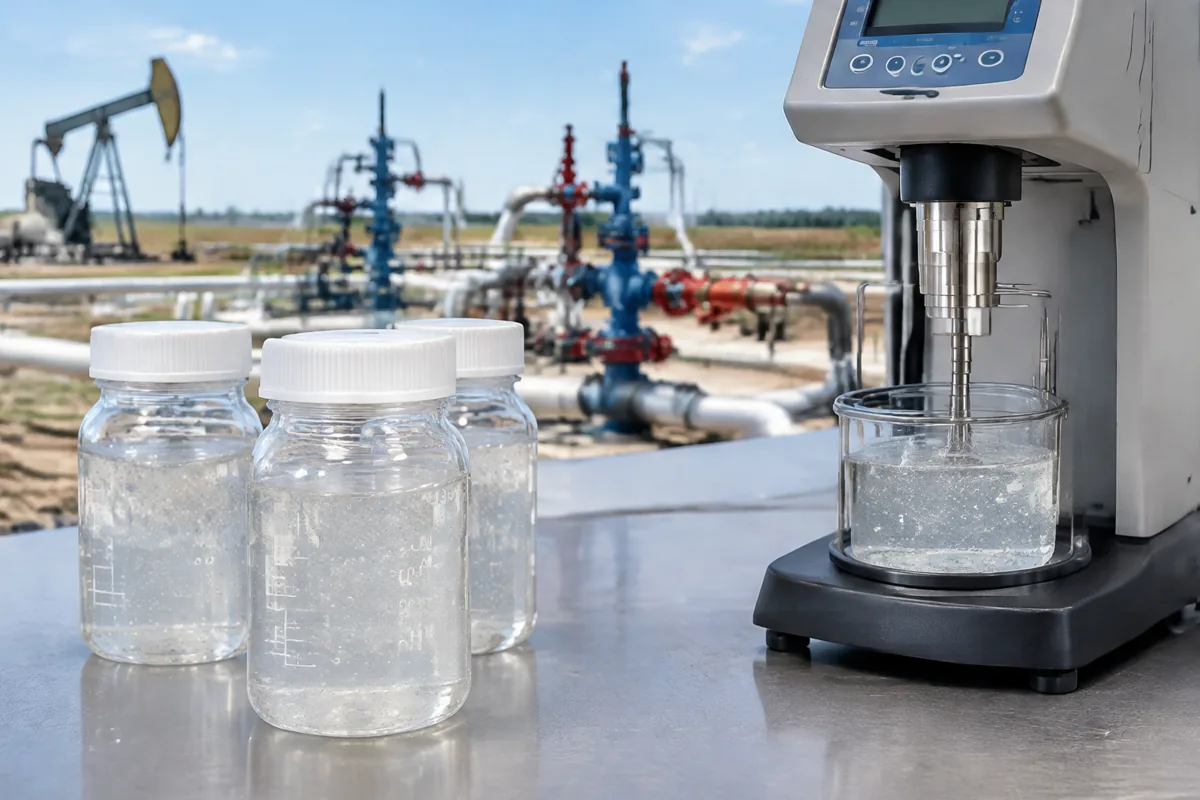
Oilfield Polymer Gel Breaking enzyme application: gel samples and viscosity-testing equipment near oilfield equipment
Oilfield Polymer Gel Breaking enzyme selection and process evaluation. Confirm product grade and suitability with the responding manufacturer.

In short

Is this relevant to your operation?

In oilfield polymer gel breaking, polymer removal requires controlled breaking time without premature loss of fluid performance or excessive residue. For oilfield and petroleum services operations in Port Harcourt, Nigeria, that is usually where the cost, yield or quality pressure sits.

  • The enzyme approach: Guar Hydrolysis Enzymes is a guar-targeted enzyme breaker formulation evaluated for controlled reduction of galactomannan gel viscosity in oilfield fluids. Its value in oilfield polymer gel breaking depends on the right grade, addition point, pH, temperature and contact time for your raw material, which the selected manufacturer reviews with you before any plant use.
  • The business question: Can a measured process improvement outweigh enzyme, implementation and qualification costs while maintaining quality?
  • Your next step: Establish a baseline, model your own numbers below, then request a controlled trial for your Port Harcourt operation.

A technical evaluation, not a guaranteed outcome. Grade, dose, availability and delivery terms need confirmation.

Process challenge

A focused approach to oilfield polymer gel breaking

In oilfield polymer gel breaking, polymer removal requires controlled breaking time without premature loss of fluid performance or excessive residue. For oilfield and petroleum services operations in Port Harcourt, Nigeria, that is usually where the cost, yield or quality pressure sits.

The role of Guar Hydrolysis Enzymes

Guar Hydrolysis Enzymes is a guar-targeted enzyme breaker formulation evaluated for controlled reduction of galactomannan gel viscosity in oilfield fluids. Its value in oilfield polymer gel breaking depends on the right grade, addition point, pH, temperature and contact time for your raw material, which the selected manufacturer reviews with you before any plant use.

Where the value may come from

Target a measurable improvement on the step where polymer removal requires controlled breaking time without premature loss of fluid performance or excessive residue. Results depend on incoming raw material and operating conditions, so value is confirmed through a controlled trial, not assumed.

The relevant starting material is identify guar or starch polymer chemistry, crosslinker, brine salinity, downhole temperature, ph, shear history and the required delay before gel breaking. guar and starch formulations are not interchangeable.. Assess biochemical performance and the full operating workflow together: a laboratory result alone is not enough to justify a plant-wide change.

Decision highlights

Measure value without compromising quality

  • Measure viscosity versus time at representative temperature and salinity, residual solids, fluid compatibility and return permeability where relevant. Benchmark against the existing breaker system.
  • Product quality against your customer specifications
  • Cost per unit of saleable output, including enzyme cost

For topline impact, additional saleable output must meet customer specifications and have demand. A faster cycle or better laboratory conversion does not automatically mean more revenue.

Operational excellence

Make the improvement repeatable

  • Standardise inputs: Record raw-material variability, baseline quality and batch size so comparisons remain meaningful.
  • Control the process window: Confirm pH, temperature, residence time, addition point and compatibility for the selected grade.
  • Protect the operator: Review the safety datasheet, storage conditions, dosing method and site-specific handling controls.
  • Track consistency: Record acceptance rate, rework, downtime and actual consumption over repeated runs, not only the best batch.
  • Own the decision: Agree quality, production, procurement and finance sign-off before scaling.

Non-negotiable safeguards

  • Reservoir performance, recovery improvement and formation compatibility cannot be assumed from a bench viscosity result. Qualify the fluid with the operator and service company before field use.
  • Confirm pH, temperature and contact time for the selected grade
  • Do not attribute every change in output to the enzyme alone

Your process · your numbers

Build your business case

Estimate cost savings, released operating time and payback for Guar Hydrolysis Enzymes. All figures are editable planning assumptions in NGN; they are not a quotation or a performance commitment.

Starting values are illustrative, with no improvement assumed; the incremental cost starts at an indicative 10% of the addressable cost. Include freight, duties, dosing, extra utilities and recurring quality-control costs in your incremental cost. Do not count the same benefit twice.

01 · Cost & savings

Cost focus: oilfield polymer gel breaking processing. Use only the portion of your annual spending that the trial could realistically change.

0%

Gross annual cost avoided

NGN 0

Net annual savings / loss

NGN -10,000

Gross = addressable cost × reduction. Net = gross − recurring incremental cost. Break-even reduction: 10%. Setup cost is included separately below.

02 · Productivity & time

Compare a baseline production batch with your trial. For continuous plants, use comparable processing windows; for field or feed applications, this models operations only, not crop yield or animal performance.

10 h
10 h

Annual hours released / added

0 h

Theoretical cycle capacity change

0%

Hours = (baseline − trial) × operations. Capacity = (baseline ÷ trial − 1) × 100. Assumes equal batch size and quality, and a cycle-time bottleneck. Demand, downtime and downstream constraints can limit realised output. Time released is not automatically a cash saving and is not added to ROI.

03 · ROI & payback

Uses the net annual savings from calculator 01. Include the one-time trial, dosing equipment, commissioning and qualification investment.

First-year net benefit / loss

NGN -10,000

First-year ROI on setup investment

Not defined

Simple payback

No setup investment entered

First-year net = annual net − setup. ROI = first-year net ÷ setup × 100. Payback = setup ÷ annual net × 12. Assumes steady benefits; excludes tax, financing, depreciation and ramp-up. Payback beyond 12 months means the setup investment is not recovered in year one.

Turn the scenario into a trial discussion

A credible case links cost, quality and capacity. Ask Enzyme Manufacturers to review your assumptions, grade compatibility and acceptance criteria before adopting a change.

Enquiries are access restricted and shared with relevant manufacturers for responding to your request. Request an NDA before sharing proprietary process data.

Application trials

From a promising idea to a qualified decision

Measure viscosity versus time at representative temperature and salinity, residual solids, fluid compatibility and return permeability where relevant. Benchmark against the existing breaker system.

  1. 1.

    Define the baseline

    Document identify guar or starch polymer chemistry, crosslinker, brine salinity, downhole temperature, ph, shear history and the required delay before gel breaking. guar and starch formulations are not interchangeable., your current recipe, operating conditions, quality limits and the costs you want to address.

  2. 2.

    Agree the trial protocol

    Confirm product grade and activity with the technical team. Set the control, proposed addition point, sample size, safety checks and acceptance criteria before dosing.

  3. 3.

    Measure matched runs

    Record measure viscosity versus time at representative temperature and salinity, residual solids, fluid compatibility and return permeability where relevant. benchmark against the existing breaker system., product quality against your customer specifications, cost per unit of saleable output, including enzyme cost. Keep input and process conditions comparable, include repeat runs and investigate both gains and adverse effects.

  4. 4.

    Validate the commercial case

    Replace calculator assumptions with measured values. Include incremental handling, freight, duties, utilities, qualification and implementation costs; reject a scenario that fails quality or economics.

  5. 5.

    Scale with controlled review

    Agree a staged rollout, monitoring responsibility and stop criteria with your production and quality teams. Confirm supply terms and product documentation before committing.

Activity, dosage, product form and pack size are confirmed for the selected grade after technical review.

Enzyme approach versus conventional treatment

An enzyme acts on a specific substrate in the process; conventional chemical or mechanical treatment has broader action and different cost, effluent, safety and quality trade-offs. Compare both on the same quality target.

Fair comparison criteria for your process
CompareDecision criterion
QualitySame saleable-product or treatment target in both approaches
Operating costTotal relevant cost, including enzyme and any changed utilities or chemicals
CapacityActual bottleneck and usable time, not just theoretical cycle speed
Risk & documentationSafety, storage, compatibility, qualification and regulatory suitability
SupplyConfirmed grade, quantity, lead time and delivery terms

Supply enquiry · Port Harcourt

Plan for your plant in Port Harcourt, Nigeria

Nigerian buyers want enzymes that hold activity in hot, humid storage, clear NAFDAC and SONCAP friendly documentation, and dependable shipments into Apapa or Tin Can Island ports with credit terms that suit local distributors.

Share your raw material, operating window, current recipe and monthly volume so the team can suggest a suitable Guar Hydrolysis Enzymes grade and a trial plan for your Port Harcourt operation.

For supply to Port Harcourt, Nigeria, share the consignee address, intended use, shipment quantity and required date. The export team can review documentation, shipment options and product suitability with your procurement team.

  • Technical fit: Send the substrate, operating window and intended outcome; not just an enzyme name.
  • Delivery readiness: Confirm import responsibilities, required certificates and shipment terms, storage conditions and handling arrangements with the quotation.
  • Commercial clarity: Request grade/activity, unit basis, packaging, sample availability, price validity and lead time. This page does not confirm local stock or a local office.

Enzyme Manufacturers is an independent enquiry platform. Your requirements can be reviewed by relevant Indian manufacturers; product availability, credentials and commercial terms are supplier specific.

Supplier qualification checklist, not platform certifications

Activity & COATDS & SDSCertification scopeTrial evidence

Request certificate scope and validity for the proposed grade and manufacturing unit. Suitability for your application and market must be confirmed.

Shipping, packaging and payment

How supply to Port Harcourt, Nigeria works

Port of loading (origin)
Indicative sourcing guidance; confirm with the selected manufacturer. Nhava Sheva (JNPT), Navi Mumbai; Mumbai Port; Mundra, Gujarat (on request). Air shipments from Mumbai Chhatrapati Shivaji Maharaj International Airport. The loading port depends on the selected manufacturer and freight arrangement.
Main discharge ports for Nigeria
Lagos Apapa, Tin Can Island, Lekki Deep Sea Port, Onne (Port Harcourt). Air cargo: Lagos Murtala Muhammed.
Delivery to your plant
Indicative sourcing guidance; confirm with the selected manufacturer. From the discharge port to Port Harcourt, Nigeria by road or rail through your clearing agent, or on DAP terms where agreed. Region: Sub-Saharan Africa.
Shipping terms (Incoterms)
Indicative sourcing guidance; confirm with the selected manufacturer. Incoterms 2020: EXW, FOB Nhava Sheva (JNPT) and CIF or CFR your port are standard; CIP and DAP on request. A 20 ft container typically carries 14 to 18 tonnes of palletised drums or bags; part loads ship as LCL consolidation, and samples and urgent lots by air.
Export packaging
Indicative sourcing guidance; confirm with the selected manufacturer. Liquids: 25 and 50 kg UN rated HDPE carboys, 200 kg HDPE drums and 1,000 kg IBC totes. Powders and granules: 25 kg multiwall bags with LDPE liner or 25 and 50 kg fibre drums. Palletised (typically 500 to 1,000 kg per pallet), stretch wrapped on ISPM 15 heat treated pallets, with product name, batch number, manufacturing and expiry date on every label. Custom packs and private labelling require manufacturer confirmation.
Payment modes
Indicative sourcing guidance; confirm with the selected manufacturer. Telegraphic transfer (T/T): 100% advance, or 30% advance with 70% against a scanned copy of the bill of lading. Irrevocable letter of credit (LC) at sight from a first class bank. Documents against payment (D/P, CAD) through banks for known buyers. Open account or usance LC (60 to 90 days) only for established buyers after review. Quotations in USD or EUR.
Export documents
Indicative sourcing guidance; confirm with the selected manufacturer. Commercial invoice, packing list, bill of lading or air waybill, certificate of origin, certificate of analysis, safety data sheet and technical data sheet; Halal, Kosher, health or free sale certificates on request.
Transit and lead time
Indicative sourcing guidance; confirm with the selected manufacturer. Production lead time plus sea or air transit to your port, confirmed with the quotation. Plan around harvest or crushing seasons and port congestion.
Storage in transit
Indicative sourcing guidance; confirm with the selected manufacturer. Enzymes travel in dry containers; temperature sensitive grades can be shipped in reefer containers on request.

Indicative information. Ports, packaging, Incoterms, payment terms and lead times are confirmed in your quotation.


Frequently asked questions

How do I find a Guar Hydrolysis Enzymes manufacturer for oilfield polymer gel breaking in Port Harcourt, Nigeria?

Enzyme Manufacturers connects buyer requirements with relevant manufacturers in India. This catalog guide covers the product, application and destination; it does not establish local stock or a nearby factory. Include intended use, operating conditions, volume and required documents so the responding supplier can assess grade and delivery feasibility.

How should I compare Guar Hydrolysis Enzymes quotations for delivery to Port Harcourt, Nigeria?

Compare the exact grade, activity method, form, validated dose, packaging and named delivery terms. Include freight, applicable taxes or duties, handling and incremental process costs. Provide guar structure, crosslinker, brine salinity, downhole temperature, pH and required break delay. Request evidence for the exact fluid. A low kilogram price alone does not establish the lowest cost per unit of acceptable output.

What results should a Guar Hydrolysis Enzymes trial in Port Harcourt, Nigeria demonstrate?

Track viscosity-time behaviour, residual solids and operator-specified formation compatibility. Do not infer improved oil recovery solely from a faster bench break. Use representative raw material and a comparable control, record lot and dose, and agree quality and safety limits before starting. Repeat important observations and replace calculator assumptions with measured results before commercial adoption.

How is Guar Hydrolysis Enzymes selected for this application?

Measure viscosity versus time at representative temperature and salinity, residual solids, fluid compatibility and return permeability where relevant. Benchmark against the existing breaker system.

What dosage should we use?

Dosage is grade- and process-specific. Share your raw material, operating pH, temperature, contact time and target outcome so the technical team can propose a trial programme.

Are the calculator savings guaranteed?

No. These are scenario estimates from your inputs, not measured Enzyme Manufacturers performance. Validate quality, costs and operating results in a controlled trial. Released time becomes financial value only if it can be used or a real cost is avoided.

Which specifications and documents should we request?

Request the current technical datasheet, activity specification, storage guidance, safety documentation and applicable certificates for the proposed product grade. Regulatory suitability must be confirmed for your intended use and market.

Can we discuss a sample for Port Harcourt, Nigeria?

Send your process conditions, trial quantity, destination and desired test date using the enquiry form. The responding manufacturer confirms sample availability, charges, packaging, shipment and technical support. Request grade-specific documents and a protocol before testing; free samples or delivery dates are not assumed.

Will our enquiry be kept confidential?

Enquiries are access restricted and shared with relevant manufacturers for responding to your request. For proprietary recipes, process data or documents, request an NDA before sharing sensitive details.

Which products should we evaluate for oilfield polymer gel breaking?

The sourcing directory includes Guar Hydrolysis Enzymes, Starch Hydrolysis Enzymes. Product names are a starting point; the selected supplier must confirm intended use, grade and application suitability.

What information should we send for oilfield polymer gel breaking product selection?

Identify guar or starch polymer chemistry, crosslinker, brine salinity, downhole temperature, pH, shear history and the required delay before gel breaking. Guar and starch formulations are not interchangeable. Include trial and recurring quantities, destination and required documentation so the manufacturer can respond to a defined requirement rather than a product name alone.

How should we measure oilfield polymer gel breaking trial performance?

Measure viscosity versus time at representative temperature and salinity, residual solids, fluid compatibility and return permeability where relevant. Benchmark against the existing breaker system. Use a comparable control, record raw-material and process variation, and repeat key observations. Assess quality limits and unintended effects before converting any improvement into an economic estimate.

What checks are needed before commercial use in oilfield polymer gel breaking?

Reservoir performance, recovery improvement and formation compatibility cannot be assumed from a bench viscosity result. Qualify the fluid with the operator and service company before field use.

Are dose, savings or field results guaranteed for oilfield polymer gel breaking?

No. Doses, performance and economics depend on the formulation and operating conditions. Calculator outputs are scenarios, not product qualification or proven results.

How can we request oilfield polymer gel breaking documents, a quotation or samples?

Send the intended use, conditions, required documents, quantity and destination through the enquiry form. Relevant manufacturers may review the requirement; availability and terms are confirmed directly by the supplier.

How do I find an enzyme manufacturer for oilfield polymer gel breaking?

Enzyme Manufacturers provides application-led sourcing for oilfield and petroleum services buyers. The catalog links Guar Hydrolysis Enzymes, Starch Hydrolysis Enzymes to this application. Describe the target reaction and actual operating window; a relevant manufacturer assesses grade fit, supply feasibility and trial support. A listing is not confirmation that every grade meets every market's requirements.

How should we compare supplier quotations for oilfield polymer gel breaking?

Compare intended use, activity method, validated dose, required documentation and delivered terms on the same basis. For oilfield polymer gel breaking, measure measure viscosity versus time at representative temperature and salinity, residual solids, fluid compatibility and return permeability where relevant. Benchmark against the existing breaker system. Include enzyme, handling and incremental operating costs, and do not double-count yield and throughput benefits.

Can we replace our existing oilfield polymer gel breaking enzyme without a new trial?

Reassess the activity method, carriers, formulation, stability and intended-use documents even if the enzyme name matches. Identify guar or starch polymer chemistry, crosslinker, brine salinity, downhole temperature, pH, shear history and the required delay before gel breaking. Guar and starch formulations are not interchangeable. Agree a proportionate qualification trial and change-control review before adopting a substitute.

Sample request · Confidential trial · Reply in two business days

Ready to trial Guar Hydrolysis Enzymes in Port Harcourt, Nigeria?

Send your process details for a confidential grade recommendation, sample and trial plan.

Enquiries are access restricted and shared with relevant manufacturers for responding to your request.

Page summary

Your next decision, in four points

  • Fit: Guar Hydrolysis Enzymes targets a specific biochemical step in oilfield polymer gel breaking; grade and process compatibility matter.
  • Evidence: Validate measure viscosity versus time at representative temperature and salinity, residual solids, fluid compatibility and return permeability where relevant. benchmark against the existing breaker system. and product quality against your customer specifications alongside all quality safeguards.
  • Economics: Compare net savings, usable capacity and implementation payback using actual trial figures, not promised percentages.
  • Action: Share your Port Harcourt, Nigeria process requirements for a technical and supply review.

Enquiries are access restricted and shared with relevant manufacturers for responding to your request. Request an NDA for proprietary details.

Discuss your requirements